Featured post

Showing posts with label Smith. Show all posts

Thursday, 6 March 2025

How ThruLines and Enhanced Shared Matches helped identify the correct Smith family

Smith has long been the most common surname in the English speaking world. So how do we correctly identify which Smith family is ours?  Can I use some of Ancestry’s tools to help confirm the correct family in a fairly populated area like the Midlands in the UK in the late 1700s? I think I have!

Midlands area c1806 [A Vision of Britain Through Time ©British Library]

In June 2024, Ancestry released Pro Tools, an add-on membership that gives you access to advanced DNA and family history tools.  Pro Tools requires an additional subscription of approximately A$15 per month (although there have been occasional sales). For the keen genetic genealogist it is a “must have” feature. 

The key DNA feature Enhanced Shared Matches lets you see how much DNA your matches share and their predicted relationships to each other. This feature is already available at MyHeritage and 23andMe, however the sheer size of the Ancestry database makes it a much more powerful tool. 

How many times have you looked at a DNA match only to see that they don’t have a tree or that their tree is only small and only lists private people.  However, if they have a close family member who has tested and who does have a reasonable tree, it can help to determine how this match might connect as well. It can also be helpful if you are working on an unknown cluster to determine who their shared common ancestor is. 

Another Ancestry tool is ThruLines, which illustrate how you may be connected to a particular DNA match through a common ancestor. You and your DNA matches must have public or private searchable trees that are linked to AncestryDNA tests, ideally at least 3–4 generations deep.

Thrulines for Mary Bratt - matches for Colin Hails

ThruLines do not validate your relationships with DNA matches, but they make it easier to view supporting information such as family trees, historical records, and shared DNA. This allows you to reach your own conclusions about how you might be connected.

 Family Tree showing my connection back to my paternal 5x great grandmother, Hannah Smith

Background 


My 5xgreat grandmother, Hannah Smith was born c1792 in Tipton, Staffordshire. She married John Plimmer on 29 September 1813 in St. Bartholomew's Wednesbury, Staffordshire. Unfortunately, as this is prior to civil registration, details of their fathers names and occupations are not provided. 

Hannah's Timeline

Hannah and her husband, John, an Edge Tool Maker (and later a Retail Brewer), had seven known children who were all born in Wednesbury between 1816 and 1830. By 1841, the family were living in the parish of Aston in Birmingham, Warwickshire and Hannah died there on 7 February 1871.  

Census records gave Hannah’s birthplace as Tipton and there were two potential baptisms there, one in 1791, daughter of David and Phebe, the other in 1795 daughter of Joseph and Hannah.  Did either of these relate to Hannah? Prior to DNA testing, I felt it most likely that her parents were David and Phebe. 

Census records confirming Hannah's birthplace

Ancestry Thrulines

Possible baptism for Hannah from
Dudley St. Thomas Bishop's Transcripts

When Ancestry’s ThruLines were introduced in 2019, there were no hints for Hannah Smith’s parentage. Over time, however, hints began to appear suggesting Henry Smith and Mary Bratt as potential parents—neither of the couples I had previously considered. 

A baptism for Hannah, daughter of Henry and Mary Smith, dated 22 July 1792, was located in the neighbouring town of Dudley, in the parish of St Thomas. This could relate to Hannah.

I began exploring the ThruLines matches, building out their trees and using Enhanced Shared Matches for each DNA kit I had access to.

In addition to my own test, I have tested my father and his maternal cousin Marilyn. I also have access to the AncestryDNA results of my paternal cousin Sandie, two third cousins (Dallas and Brad), and a third cousin twice removed, Victor. All share Hannah’s daughter, Mary Plimmer, as their most recent common ancestor.  

DNA Testers

For my father and Marilyn, I can view ThruLine hints back to Henry Smith and Mary Bratt as their potential 5x great-grandparents—the furthest back ThruLines will extend. I can also view Victor’s ThruLine hints, as they are his 4x great-grandparents.

Summary of potential ThruLines matches for Colin, Marilyn and Victor 

This table summarises the number of DNA matches suggested by ThruLines for each of the three kits, across six of Henry and Mary’s children.

As Henry and Mary are 6× great-grandparents for Sandie, Dallas, Brad, and myself, our ThruLines do not extend that far. However, I was still able to identify shared DNA matches with individuals found in the earlier analysis.

Enhanced Shared Matches


I will now focus on my review of my father’s matches through Mary’s son Henry, using Ancestry’s Enhanced Shared Matches (Pro Tools).

ThruLines for Mary Bratt through son Henry Smith - potential matches to Colin

While exploring these matches individually, I noticed that many of their shared matches overlapped with other Smith/Bratt descendants, as well as descendants of Hannah Smith and John Plimmer, or their daughter Mary Plimmer and her husband Henry Williams.

Enhanced Shared Matches Example

The table below summarises the number of shared matches and the range of centimorgans they shared with Colin and the match. It also shows how many known or confirmed matches each has and how many of these also had Common Ancestor hints. Of the known matches I've then broken down which generation the shared match comes through. 


Clustering


After analysing all matches, I created a matrix depicting 76 shared matches across six of Henry Smith and Mary Bratt’s children. Unfortunately, because many matches are under 20 cM, Ancestry’s clustering feature did not generate useful visuals. This chart was therefore prepared manually using Excel.

Matrix of Smith Bratt matches

As expected, we share more matches with Hannah’s descendants, as this is our direct line. However, it is encouraging to see multiple shared matches across several branches of the family, providing additional support in lieu of segment data.

The McGuire chart below further illustrates shared matches across different branches of the family.

McGuire Chart of Smith/Bratt Matches

By building out the trees for all ThruLines matches, I was able to identify several additional matches with small or unlinked trees that had not appeared as Common Ancestor hints. As a result, I have now identified 99 known matches.

Confirmed matches through children of Henry Smith and Mary Bratt


I’ve also identified an additional two children. While we don’t have genetic evidence with the 6 testers that I've analysed, it’s possible their descendants may match with others in the broader group of matches.

Chromosome Analysis


I also examined matches who had uploaded their DNA to sites offering segment data and identified several triangulated groups. These could be traced back through the Phibbs/Williams, Williams/Plimmer, Plimmer/Smith, and ultimately the Smith/Bratt line.


Phibbs, Williams, Plimmer, Smith, Bratt segments

Reviewing each triangulated group helps confirm connections across generations.
 
Segment data summary

Stephen is a known fourth cousin who descends from Henry Williams and Mary Plimmer through their daughter Ada, as does R. Allway, who likely descends from the same couple. Kimberly and several other “unknown” matches are also shared matches for Phillip and Carole, suggesting this segment may trace back to the Smith/Bratt couple.

Charlotte and Phyllis are both confirmed Plimmer/Smith descendants. After initially writing this blog and sharing it with matches, Jane uploaded her results to GEDmatch. As she triangulates with Charlotte, this adds further confidence that the segment originates with the Smith/Bratt line.

Additional Documentary Evidence


As a welcome surprise, I uncovered additional documentary evidence. John and Hannah Plimmer appear as witnesses at the marriages of two of Hannah’s sisters.

The first is the marriage of Mary Smith to John Wesley in 1825. Unfortunately, I have only been able to locate a transcript for this marriage on FreeREG.

The second is the marriage of Phoebe Holmes (née Smith) to George Sillitoe in 1834, for which I located a poor-quality image confirming John and Hannah as witnesses.

Marriage of George Sillitoe and Phoebe Holmes (nee Smith)

The 1861 census shows Phoebe Sillitoe and her daughter Hannah living with Phoebe’s sister Elizabeth Hobbins in West Bromwich, along with two of Elizabeth’s granddaughters—an excellent example of the FAN Club principle (Friends, Associates, and Neighbours).


Another notable observation is the repetition of certain given names, particularly Syndonia (16 occurrences) and Phoebe (12 occurrences). 

Research Conclusion


On the balance of probabilities, I am confident that both the genetic and documentary evidence support my conclusion that Hannah Smith was the daughter of Henry Smith and Mary Bratt, my 6× great-grandparents.

I would encourage anyone who has taken an AncestryDNA test to consider uploading their results to databases with a chromosome browser, such as:
  • FamilyTreeDNA
  • Gedmatch
  • LivingDNA
All of these sites offer free uploads, with only a nominal fee required to access advanced tools.

Click here for instructions on how to download your Ancestry data and upload to other databases.  

Version


This blogpost was originally published on 6 March, 2025 and updated on 10 January, 2026.


Thursday, 5 May 2022

Finding the Forrest family - using chromosome analysis

A DNA match alone doesn't prove a relationship to a particular ancestral couple, but they can provide further evidence to support a theory. In this case, a collection of DNA matches who also shared the same segment of DNA helped to identify further children of the ancestral couple and provided further evidence to confirm their relationships. 

This is my mum's chromosome map - what is a chromosome map and how did some of this information help me find the Forrest family? 

Mum's Chromosome Map from DNA Painter

Chromosome mapping is a technique used in genetic genealogy using autosomal DNA results. The goal is to identify which ancestors were the source of various segments of your DNA.  Once you discover how you’re related to someone, you can figure out which ancestor is likely to have been the source the DNA you share with them. It's an ongoing process and to date, I've mapped or assigned about 46% of mum's genome to known ancestors. It's just like a jigsaw puzzle! Each colour represents confirmed DNA matches to a specific ancestor or ancestral couple. 

Legend - Mum's Chromosome Map

Below is the pedigree chart for my maternal grandmother, Helen Forrest McDougall, using the Ancestral Trees tool from DNA Painter website. I’ve also used the DNA Filters feature to indicate those ancestors that I’ve been able to confirm through DNA analysis. 

Pedigree Chart for Helen Forrest McDougall showing DNA confirmed ancestors

Prior to DNA testing I had been unable to research my tree beyond my grandmother's great grandmother and namesake, Helena Annie Forrest. I've recently identified over 25 DNA matches back to Helena’s parents - my 4th-Great-Grandparents, David Forrest and Margaret Anderson and a further 12 DNA matches back through Margaret’s parents, James Anderson and Cockburn Smith, my 5th-Great-Grandparents, enabling me to take my research back a further two generations. 

Helena married Alexander Dougal (later McDougall), a weaver,  in Girvan, Ayrshire, Scotland in 1835. She can’t be identified on the 1841 census, but is on the 1851 census in Girvan with her husband and children. The census indicated that she was born about 1819 in Edinburgh. Her son, George, my 2nd-Great-Grandfather, was born in 1855 and his birth certificate also states that his mother was born in Edinburgh. Unfortunately, while Helena is listed on all the later census, they indicate that she was born in Girvan, which was not helpful!

Death Certificate - Eleanor Annie McDougall - 16 October 1886

Helena's death certificate in 1886 provided details of her parents, David Forrest, a shoemaker and Margaret Anderson, and confirmed that they were both deceased. 

I tested my mum at Ancestry in 2018 and also have access to two of my aunts kits, I have also tested Mum at 23andMe. Mum and her sisters results have since been uploaded to other sites including MyHeritage, Family Tree DNA (FTDNA) and Gedmatch. These sites provide access to their shared segment data with their matches, which is required to undertake chromosome analysis, and also identifies matches who may have tested and/or uploaded to the other sites. I’ve confirmed DNA matches back to Helena and her husband Alexander through 3 of their children at Ancestry and more recently at 23andMe. 

Confirmed DNA matches back to Helena Forrest and Alexander McDougall

No baptism for Helena can be found in the Old Parish Registers, but I have located baptisms for five children born to a David Forrest and Margaret Anderson between 1800 and 1807 in Livingston, Midlothian, which is about 25 km west of Edinburgh. There is a gap between the last recorded baptism for David in 1807 and Helena’s possible birth, but could they also be her parents?  

Baptisms at Scotlands People for children of David Forrest and Margaret Anderson

I decided to add the family to my Ancestry tree, also adding the Research Status tree tags Hypothesis and Unverified to warn anyone else that they were still speculative.

Using Tree Tags at Ancestry 

ThruLines™ is an Ancestry feature that groups your DNA matches under potential common ancestors, so I was excited to see soon after updating my tree, that ThruLines™ had generated a couple of potential matches, through a son named Peter Forrest. 

ThruLines™ showing potential DNA matches through descendants of David Forrest 

Like my ancestor, Helena, there was no baptism record for Peter either, however, census records indicated he was born about 1817 in Blackburn which is also near Livingston in Midlothian. His death certificate gave his parents as David Forrest, a master shoemaker and Margaret Anderson, so could he be another child of this same couple? 

Peter and his wife, Isabella Wilkie had 9 children and we now had DNA matches through three of those lines.  As a result, I added Peter and his children to my tree using the Hypothesis and Unverified tree tags while I continued searching and gathered more evidence.

Fast forward a few months and I received a message from Cathy in Canada, a 3rd cousin DNA match, who I’d contacted a few years earlier, asking me how confident I was that David Forrest and Margaret Anderson were Helena’s parents. 

I was reasonably confident as mum and her sisters shared many of the same matches with Peter’s descendants, which had provided us with tree triangulation and the family names also supported the connection. However, given the matches were beyond 3rd cousins, we really needed to be able to compare segment data. 

Although Cathy and mum shared 29 centimorgans (cM) at Ancestry - they had no shared matches, other than myself and one of my aunts. Although they both matched Cathy, neither of my aunts had any additional shared matches with Cathy either, so I was curious to know if Cathy matched with any of Peter Forrest descendants, or the matches from 23andMe. 

Mum's match with Cathy in Canada and their shared matches
Sharing preferences 

Cathy agreed to share her match list with me as a collaborator as I had offered to start grouping her matches for her. Cathy had also uploaded to MyHeritage where she and mum shared 42 centimorgans, which was consistent with Ancestry’s unweighted results.  

Comparison of Mum and Cathy's matches grouped into the McDougall and Forrest lines

Once I had access to Cathy’s match list I was able to confirm that she too shared several of the matches from the Peter Forrest line. As these were mostly below 20 centimorgans, they had not appeared in the shared match tab for any of Ancestry kits I had access to.   

I could also see we shared many other potential matches and added them to our groups for further analysis. 

I continued to build out my tree and Ancestry’s ThruLines™ updated again, identifying more matches through another two possible children of David and Margaret - Margaret and Jessie. 

ThruLines™ showing suggested matches through descendants of Margaret Anderson

Once again, no baptism records for Margaret or Jessie could be found, however both gave their father’s name as David Forrest, a cordwainer or shoemaker at the time of their marriages, and their parents were recorded as David Forrest and Margaret Anderson at their deaths, so I'm confident they are all descended from the same couple. 

Analysis of Cathy’s shared matches with mum and her sisters at MyHeritage revealed that some of the Ancestry matches had also tested or uploaded to MyHeritage. I was able to compare the shared segments for these matches and confirmed that they triangulated - meaning they shared some of the same segments.  MyHeritage add a symbol to the right of the match indicating they share triangulated segments. 

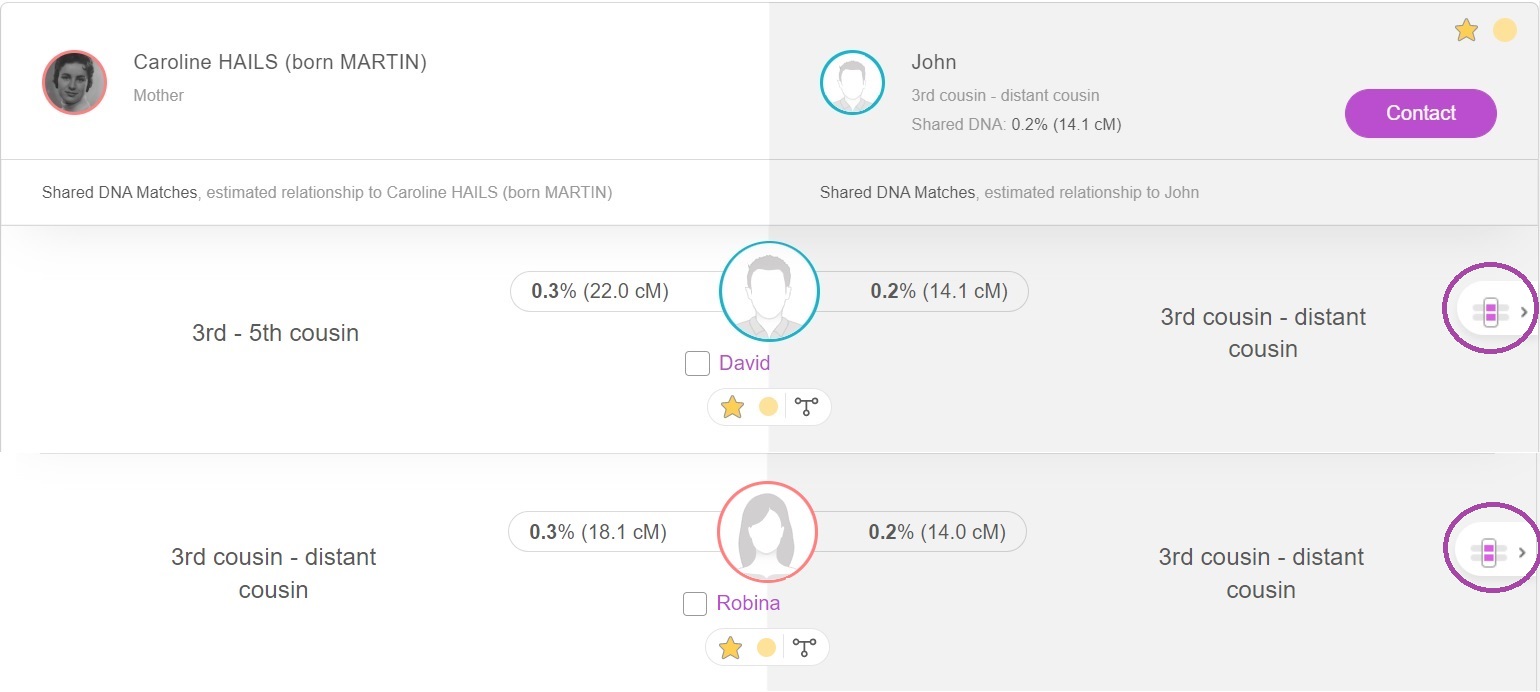
Mum's match with John at My Heritage showing triangulated matches with David and Robina

Some of these new matches, like David and Robina, take us back yet another generation, to Margaret’s parents - James Anderson and Cockburn Smith, and are descendants of Margaret’s sister, Susan.

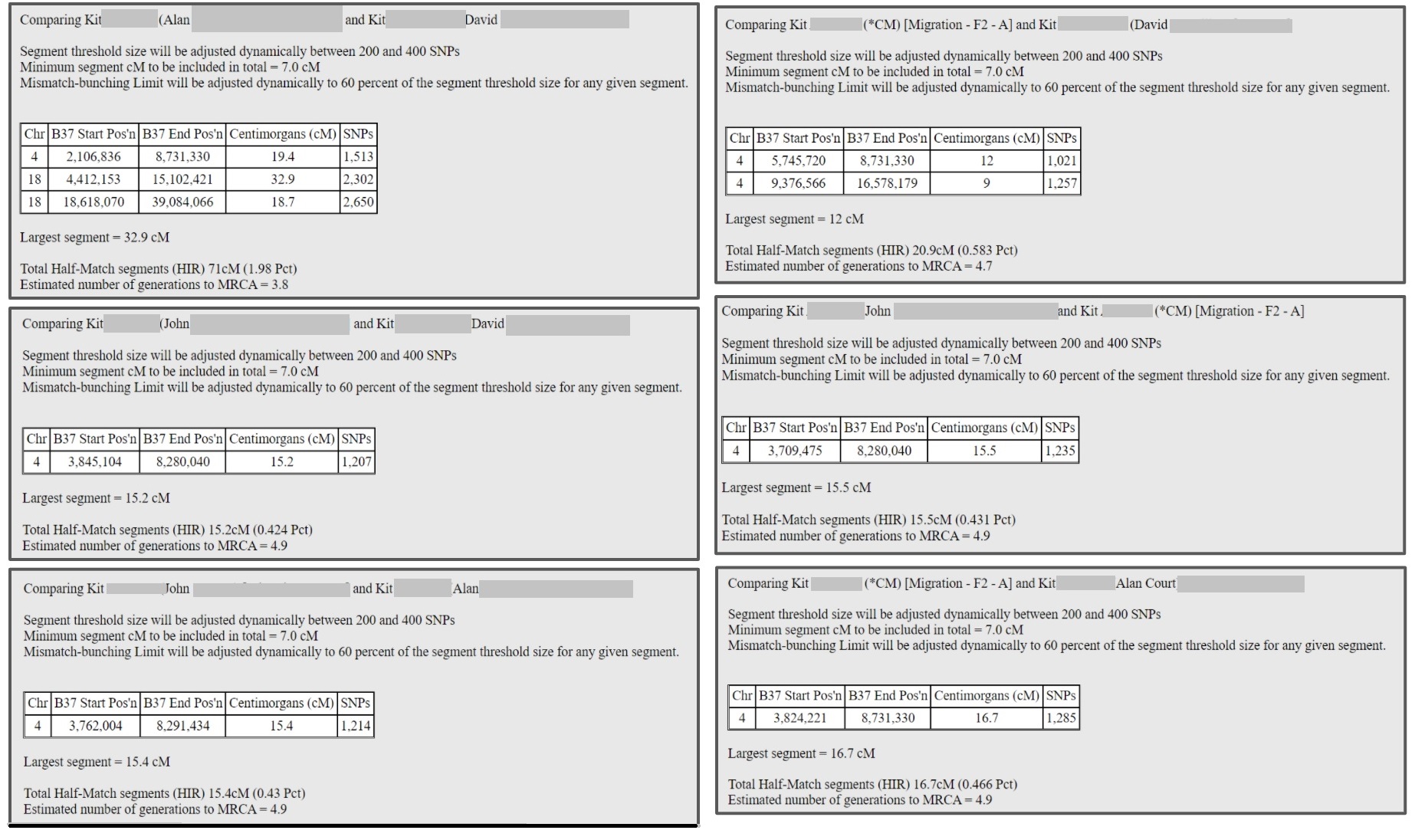
Comparison of kits at Gedmatch between Mum, John, David and Alan 

David and John were good bridging matches between the sites, as they had also uploaded to Gedmatch, where I was able to compare the various kits with each other. 

Both David and Robina also shared their Ancestry results with me as well, which was helpful in confirming where many of the other shared matches connected in our trees. 

Mum also had known matches at 23andMe that I had already identified and painted into mum’s chromosome map. 

Mum's known matches back to Helena Forrest and Alexander McDougall from 23andMe

The chromosome map at DNA Painter allowed me to paint our shared segments from all of the sites and visually compare the overlapping segments. Below is a snapshot showing all available segment data between each of the matches with mum and her sisters back to their most recent common ancestral couple. 

Mum's chromosome map showing matches back to the McDougal/Forrest/Anderson/Smith lines

I have zoomed in on those chromosomes where we have triangulated segments. Primarily Chromosomes 4, 6 and 7.

Chromosome Map focus on David's shared segments

You may see slightly different results for the same match at different testing sites as they do test at different locations. For example, David has uploaded his Ancestry results to both MyHeritage and Gedmatch. Gedmatch reports that he shares two small segments on chromosome 4, while MyHeritage uses imputation to add to the results of people who upload results from different vendors, and in this case appear to have joined these segments together.

Chromosome Map - Chromosome 4

In relation to the shared segments on Chromosome 4, you can see that I have currently mapped them to the three sets of Common Ancestors, based on the relationship of the match to mum:

  • Graeme, a 3rd cousin, once removed (3C1R), is mapped to the 2nd-Great-Grandparents, Alexander McDougall and Helena Forrest 
  • John, a 4th cousin, is mapped to the 3rd-Great-Grandparents, James Forrest and Margaret Anderson 
  • Alan, David and Robina, all 5th cousins, are mapped to the 4th-Great-Grandparents, James Anderson and Cockburn Smith 

However, all these segments can actually be attributed and painted to the 4th-Great-Grandparents, James Anderson and Cockburn Smith.

Chromosome Map - Chromosome 6

While, Chromosome 6 can be attributed to the 3rd-Great-Grandparents, James Forrest and Margret Anderson. 

I have also asked Robina if she would consider uploading to Gedmatch, as I am sure my mum shares this segment with her and that there is an anomaly at MyHeritage, as Robina shares this segment with my aunt, my sister and my niece. 

Thrulines™ showing suggested matches through descendants of James Anderson

Through collaboration with David and Robina and sharing our Ancestry results with each other we've now also been able to build and confirm our trees back further. Mum's Thrulines™ has identified a further 9 matches back to the next generation - James Anderson and Cockburn Smith, through their daughters, Susan and Isobel. 

While Thrulines™  are great for providing hints as to how we connect with some of our matches, I use a spreadsheet for tracking all our known matches and also use a programme called GDAT (Genealogical DNA Analysis Tool) to analyse matches further. 

The What Are The Odds tool (WATO) at DNA Painter a simple way of visualising matches across the different platforms and it’s also an easy way to share information with others working on the same families. I'm also now adding a link to the privatised WATO tree to the profiles for the Common Ancestors in my Ancestry tree.  

WATO tool used to track confirmed matches

I would love for more of our shared matches to upload to sites with a chromosome browser. I know we have inherited additional DNA through other segments from these couples. My Auntie Irene doesn’t share these segments on Chromosome 4 or 6 with any of these matches that I've used in this analysis, but she is a match with several other matches on these lines at Ancestry - so it must be on a different chromosome/s! 

Many thanks to Cathy, David, Anne, Robina and Nicolette for sharing their Ancestry results with me.