I hope you will enjoy following me down a few rabbit holes as I not only evaluate our DNA matches, but delve into a variety of records to tell more of the story of this family!
What did we already know?
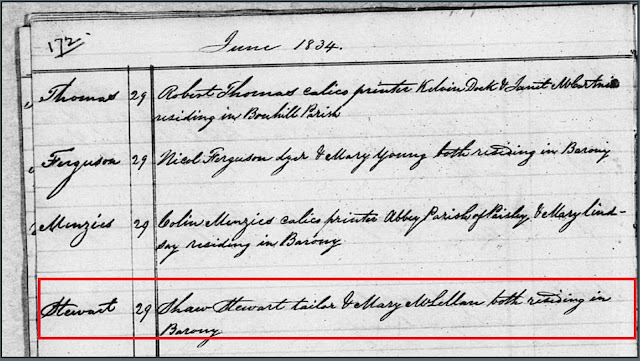
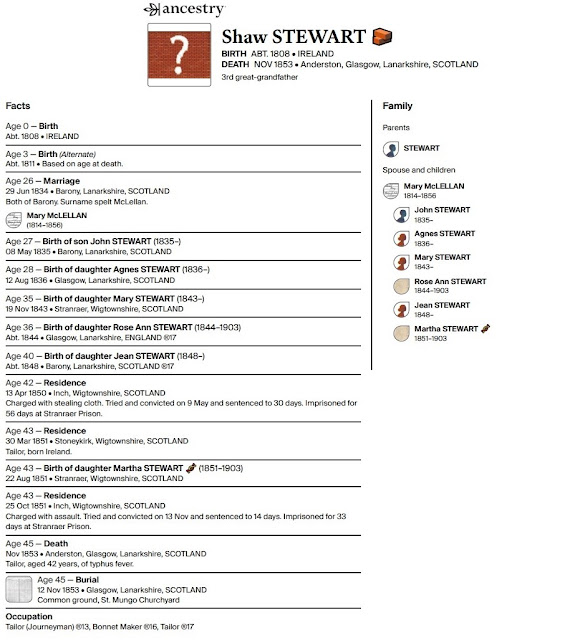
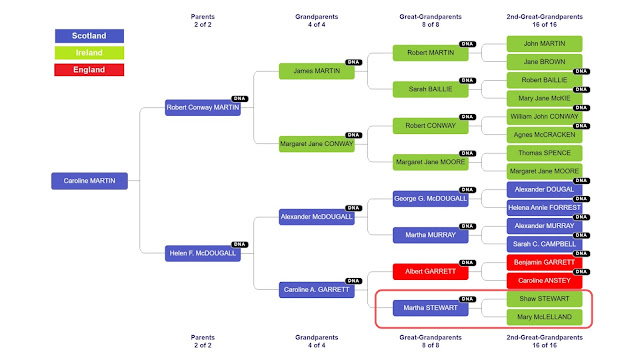
Shaw and Mary were living in Stoneykirk, Wigtownshire near Stranraer at the time of the 1851 Census. My 2 x great grandmother, their daughter, Martha was born on 22 August in Stranraer, a few months after the census was taken.
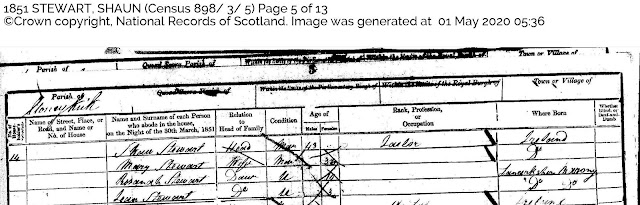
Shaw was described as a tailor (incorrectly transcribed at Ancestry as a sailor) and the census states that both he and Mary were born in Ireland. They had two daughters living with them at the time, Rosannah and Jean, both born in Barony, Glasgow.
I have also identified Shaw in the Criminal Register Indexes which you can search at the Scottish Indexes website. He was charged with theft in 1850 and assault in 1851. He was convicted on both occasions and spent a total of 89 days in Stranraer Prison.
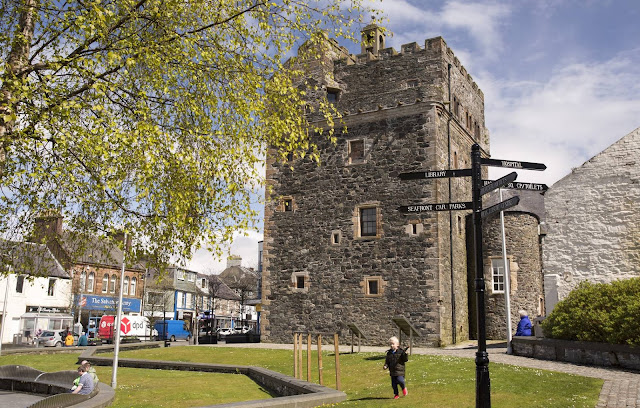 |
| Castle of St John, Stranraer © Scotland Starts Here |
The Castle of St John sits in a prominent position in the centre of Stranraer and was built around 1500 by the Adairs of Kilhilt, one of the most powerful families in Wigtownshire. In the late 1670s it was used as a military garrison for the government troops commanded by John Graham of Claverhouse. In the Victorian period it was used as a jail. Today it houses a museum.
The Registers give a good descriptive image of Shaw. He was of average height for the time at 5 foot 6 and half inches tall and weighed between 140-146 pounds. He had brown hair and grey eyes.
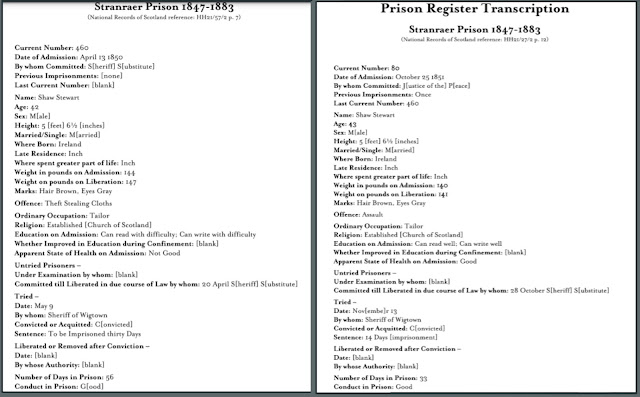 |
| Transcripts from Criminal Register Indexes for Shaw Stewart |
On the 1850 charge he could read and write with difficulty, and was not in good health, however, in 1851 he could read and write well and was recorded as being in good health!
The other interesting information is that although he was born in Ireland, both records stated that Shaw had spent most of his life in the parish of Inch.
The assault charge was also reported in the local paper the Dumfries and Galloway Standard on 19 November 1851. His daughter Martha was just 4 months old at the time.
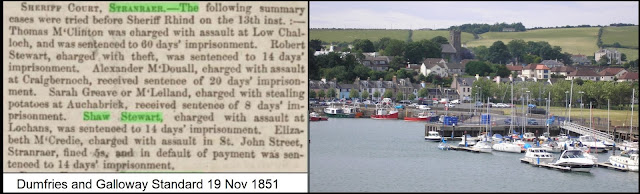
Stranraer is where you get the ferry from Scotland to Belfast in Northern Ireland and I took this photo from the ferry in 2010.
I have no record of Shaw and Mary as a family group after this and believe Shaw is the one who died of typhus in Glasgow in 1853 and was buried in common ground at St Mungo Burial Ground.
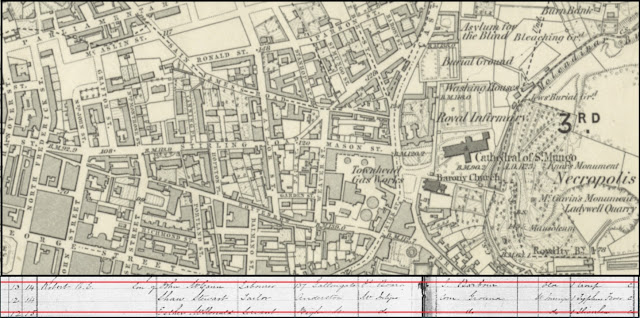 |
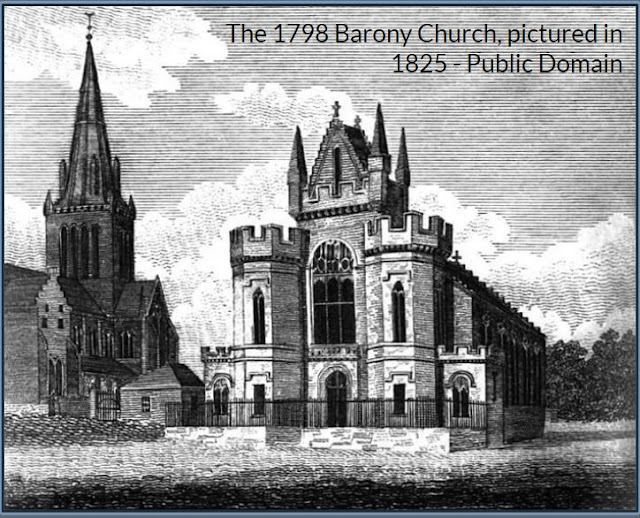
| Burial record for Shaw Stewart and map of Glasgow showing St Mungo Burial Ground, the Royal Infirmary and Barony Church OS Six Inch 1843-1882 © maps.nls.uk |

Martha was still living with Rose Ann and her family 10 years later at the time of the 1881 census at 133 Springburn Road, her occupation Thread Mill worker.

Three days after the census was taken, on 6 April, Martha married Albert Garrett. The certificate confirms that both her parents were deceased. Martha and Albert went on to have a family of 7 children, including my great grandmother, Caroline Anstey Garrett.

DNA Analysis
A few months ago, several members of our extended family in the USA took DNA tests with Ancestry - including two of mum’s second cousins, providing solid genetic evidence back to their shared great grandparents, Martha and her husband, Albert Garrett.
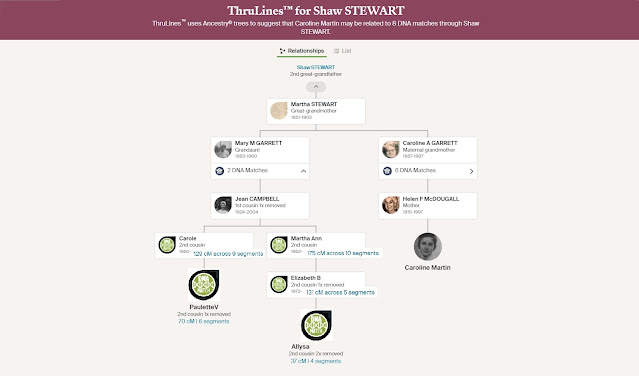 |
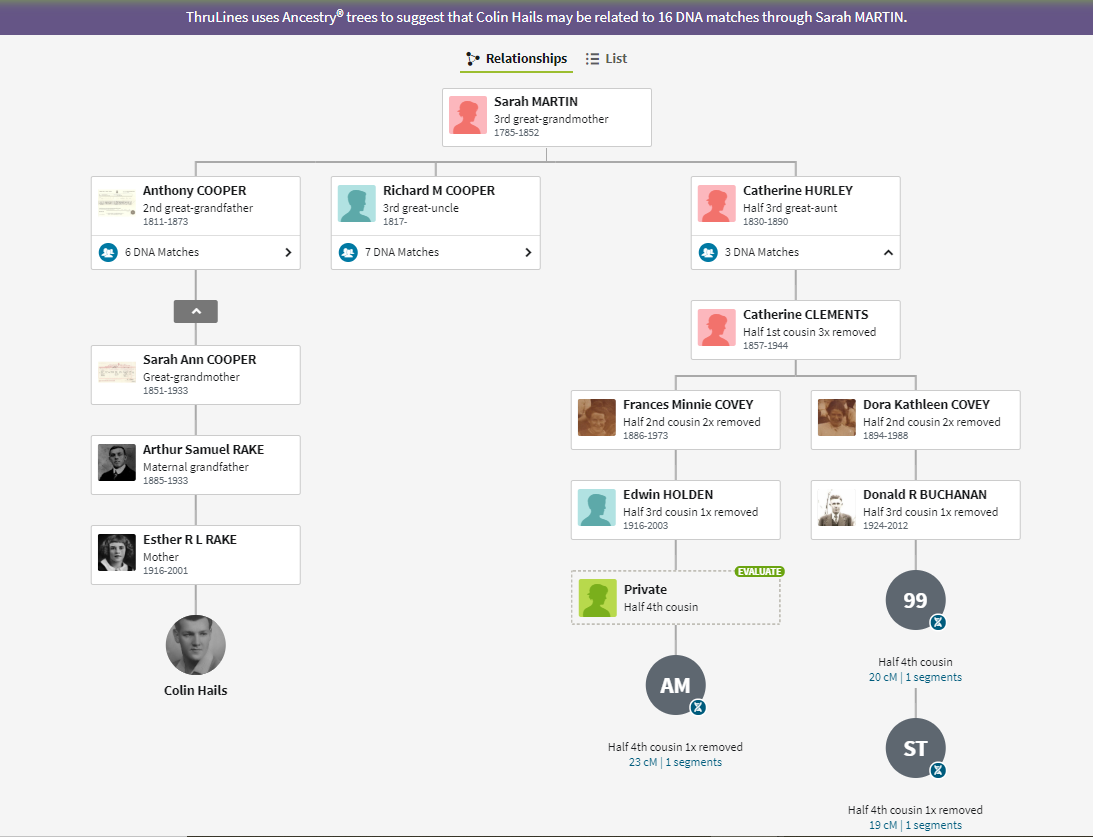
| Thrulines from Ancestry for Shaw Stewart through daughter, Martha Stewart |
I asked cousin Martha if she would share her results with me, as this allows you to view matches through a different lens. Mum and Martha’s highest unknown shared matches were a mother and daughter, Doreen and Linda. They shared between 25 and 65 centimorgans with mum, her two sisters and their second cousin, Martha. A centimorgan is a unit used to measure genetic distance and is used to describe how much DNA you share with your match. Generally it is abbreviated at testing sites to cM.
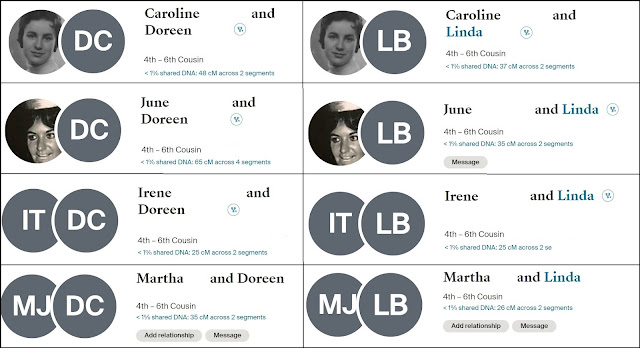 |
| DNA comparisons at Ancestry between Carol, June, Irene and Martha with their matches, Doreen and Linda |
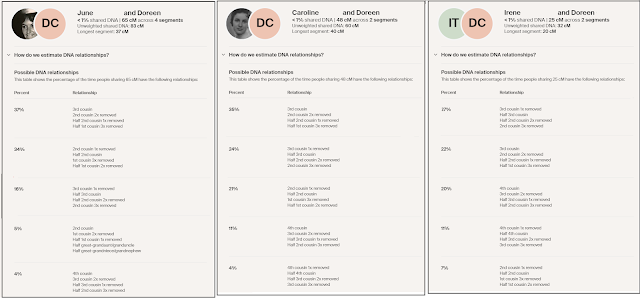 |
| Possible DNA Relationships for June, Caroline and Irene with Doreen from Ancestry based on shared DNA |
Fortunately, Linda had a linked tree and using the Ancestor Birth Locations map view, which looks for birth locations that appear in both trees, Ancestry identified Agnes/Ann McClaren and William Watson from Linda’s tree as also being born in Glasgow. Linda’s tree showed that this couple had married in Barony, Glasgow in 1846 and that they had 3 children. They had lived in Bathgate near Edinburgh for a time, returned to Glasgow, before finally settling in Castleton, Lancashire by 1881.

The name McLellan in our records had also been recorded as McLaren at different times, so I wondered if this might be our connection and sent off a message to Linda who managed both their kits.
Looking at mum’s shared matches with Doreen were two further unknown matches, Sue and L.T. Interestingly, Sue also has McLellan’s in her tree - but I’ll come back to Sue later. L.T. who has no tree, still remains a bit of a mystery match.
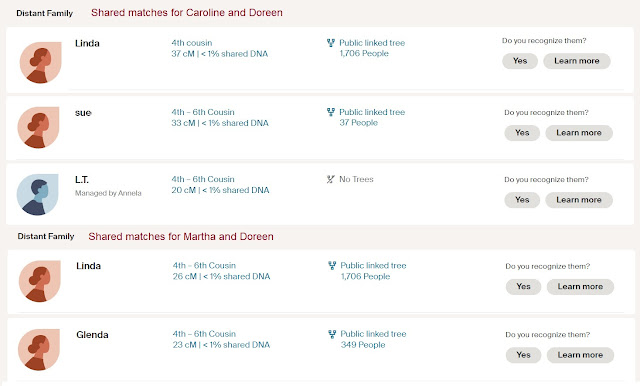 |
| Shared matches at Ancestry for Caroline and Martha with Doreen |
Martha and Doreen also had a shared match with Glenda - whose tree revealed that she was also a descendant of Agnes McLaren and William Watson, a known second cousin to Linda and a 1st cousin, once removed to Doreen.
Glenda does actually a match mum and both her sisters, but as she only shared 9 centimorgans with mum and even less with her sisters she had not appeared in the shared match lists with Doreen or Linda. While Ancestry reports your shared matches down to 8 centimorgans, they only display shared matches that are above 20 centimorgans in the shared match tab.
So a message was sent off to Glenda as well.
Back to traditional research
In the meantime, as the name Watson had also rung a bell, I did a little more research. I’m very fortunate that my 2 x great grandfather, Albert Garrett - Martha Stewart’s husband recorded events that impacted upon his family and friends.
There on page 2 of Albert's papers, was an entry for an Agnes Watson who had died on 12 March 1880 in Parliamentary Rd.
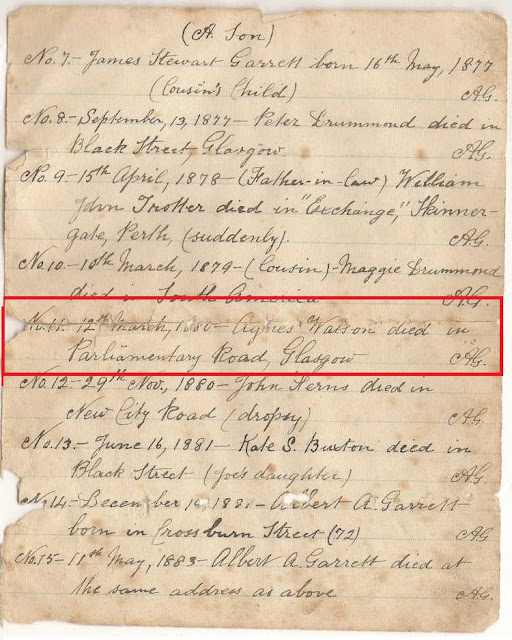 |
| Page 2 from Albert Garrett's family papers |
Many of the entries state their relationship to Albert, but unfortunately, nothing was included alongside this entry.
I checked the indexes at Scotland’s People, located the entry and noted that Agnes was aged 25 giving her a birth year c1855 and that her mother’s maiden name was McLaren.
Could she be a daughter of our matches ancestors - Agnes McLaren and William Watson?
 |
| Scotlands People - Statutory Registers - Death Index - Search Results |
Curiosity got the better of me and I purchased the certificate which confirmed that Agnes's parents were William Watson and Agnes McLaren as I’d expected. Agnes had died of bronchitis at 142 Parliamentary Rd and the informant was an aunt, Jane McLaren.

I subsequently found a McLellan family living in Main St, Barony on the 1841 census which included a Jane and an Agnes and three more possible sisters, Margaret, Sarah and Martha along with a likely mother, Nancy. All were born in Ireland with the exception of the youngest, 10 year old, Martha.

I then came across this entry below in the Commissioners' Report of Children's Employment and believe it relates to the same Agnes McLaren. The census indicated that she was employed at Printfield and I expect that is was why there was a cross next to her name on the census entry.

You can also see in this map how close Main Street, where the family lived, was to North Street, where young Agnes worked.

The Royal Commission of Inquiry was conducted in 1842 and investigated the condition and treatment of child workers.
The first report focused on the working conditions within the mines and led to reform through the 1842 Coal Mines Act. The second report covered a variety of trades: textiles, printing, tobacco production, and more. The report shed light on the harsh reality faced by child labourers. It documented the hours they worked, their ages, and the dangerous nature of some of their work.
Sub-commissioners travelled across Great Britain and Ireland interviewing children and young adults, as well as parents, adult employees, educators, medical professionals, and clergymen.
The report caused a shift in public opinion and led to the Factory Act of 1844, which reduced the number of hours children worked in a day from up to thirteen hours to six and a half hours. After reading the report, Charles Dickens was inspired to write A Christmas Carol.
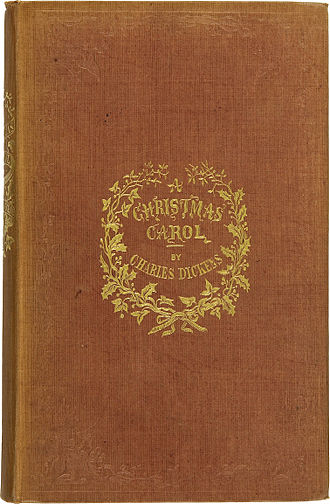 |
| A Christmas Carol by Charles Dickens - First Edition Cover (1843) Public Domain |
I had previously found a Jane McLaren on the 1891 census living at 169 Dobbies Loan - a familiar address that I recognised from Albert’s notes. Living with Jane at the time, was a Jane Drummond, recorded as her niece. Jane is a daughter of Peter Drummond and his wife, Agnes McDonald. As Peter was a cousin to Albert Garrett - Martha Stewart’s husband - why did Jane McLaren refer to Jane Drummond as her niece?

I remembered that I had a copy of Peter Drummond’s marriage certificate that had been kindly shared by another DNA match at MyHeritage. A match I had believed to be connected through our Garrett/Anstey line!

When I re-examined this certificate I noticed that Agnes Drummond’s mother’s maiden name was Martha McLaren! Could she be the 10 year old from the 1841 census?
I found the baptism for Martha McClelland which confirmed it was - her parents were James McClelland and Agnes Ross and the entry also indicated that she was their 7th child.

I had previously tried to locate the death of my ancestor, Mary Stewart nee McLellan between 1851-1871, but with such a common name and the results spanning both the Old Parish Registers and Statutory Registers timeframes there were over 60 entries to suit her approximate age, just in Glasgow City. Too many to be able to identify the correct entry.
However, by this time, I was feeling quietly confident that this was all the same family, so I narrowed my search results significantly by including those whose mother’s maiden name was Ross. As you can see it took two attempts to download the correct entry, which was the one in 1856.

Like her husband, Mary also died of typhus at the Glasgow Infirmary. She was described as the wife of a tailor and her parents' names were confirmed as James McLellan and Agnes Ross. The informant was once again, Jane McLellan, her sister.

This also confirmed that Jane Drummond from the 1891 census, had a double relationship - her father Peter Drummond was Albert Garrett’s cousin, their mother’s Jane and Caroline Anstey being sisters. Jane’s mother Agnes McDonald and Martha Stewart were also cousins, their mothers, Martha and Mary McLellan were sisters.
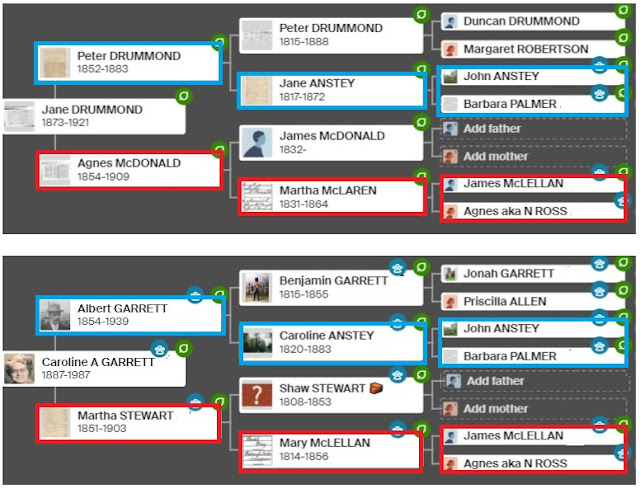 |
| Pedigree charts for Jane Drummond and Caroline Garrett - double relationship |
This also meant our DNA match at MyHeritage may well be through the McLaren/McLellan line, not the Anstey line as previously believed!
I also noted that on Mary’s death certificate, that her mother was not recorded as deceased, which prompted me to look again for Agnes McLaren/McLellan on the 1851 and 1861 census.
While I am still unable to locate Agnes on the 1851 census, she has been identified on the 1861 census at 34 Duke St with her daughter, Jane. Also living with them were two grandchildren, James Stewart and Agnes Watson, both aged 7 years.

Young Agnes is the one who died in 1880 that was mentioned in Albert’s notes and I believe James is likely to be a previously unknown younger brother to my ancestor, Martha.
Agnes McLellan nee Ross, died in November, later that year at the same address of pneumonia. The wonderful Scottish certificates providing the names of her parents - James Ross and Margaret Smillie, allowing me to take my tree back yet a further generation. The informant was her granddaughter, Rose Ann Stewart, sister of my ancestor Martha.

Below is Agnes' family tree showing her parents, known children and grandchildren. I've highlighted those whose records helped join the dots and connect these families. You might recall Martha’s baptism indicated that she was the couple’s 7th child, but as you can see, I have only identified six children! Who is the 7th child?

More DNA Analysis
I have exchanged messages and emails with Linda and Glenda. Linda has also given me collaborator access to hers and Doreen’s DNA results. This has been a huge benefit and after much analysis of their kits I can now place 15 matches in our tree back to our 3 x great grandparents - James McLellan and Agnes Ross through three of their daughters, Mary, Agnes and Martha. Brian is a match at 23andMe and Isobel at MyHeritage.

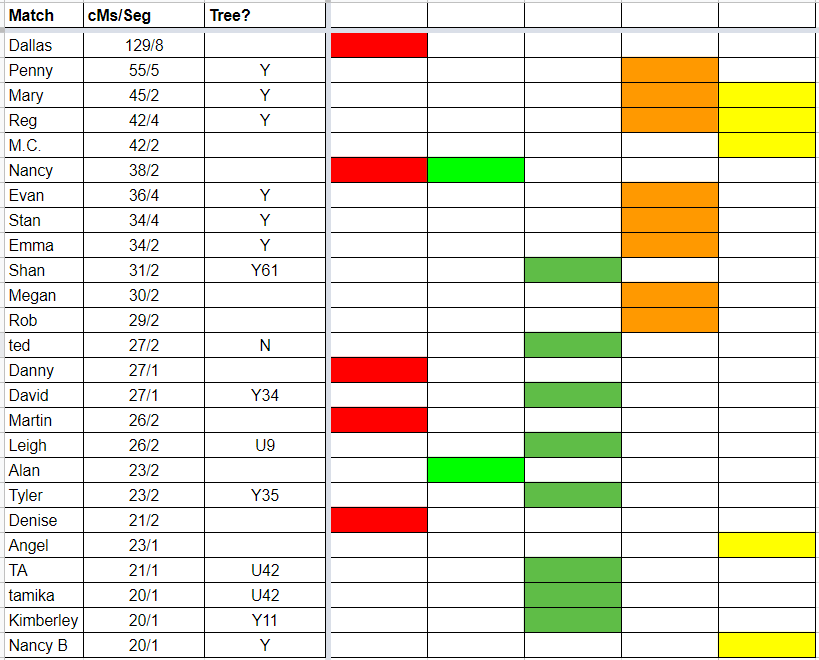
I’m a big fan of Ancestry’s coloured dots and group our matches to the sixteen 2 x great grandparents for each kit I manage. I also have a number of other “project related” groups that will vary from kit to kit.
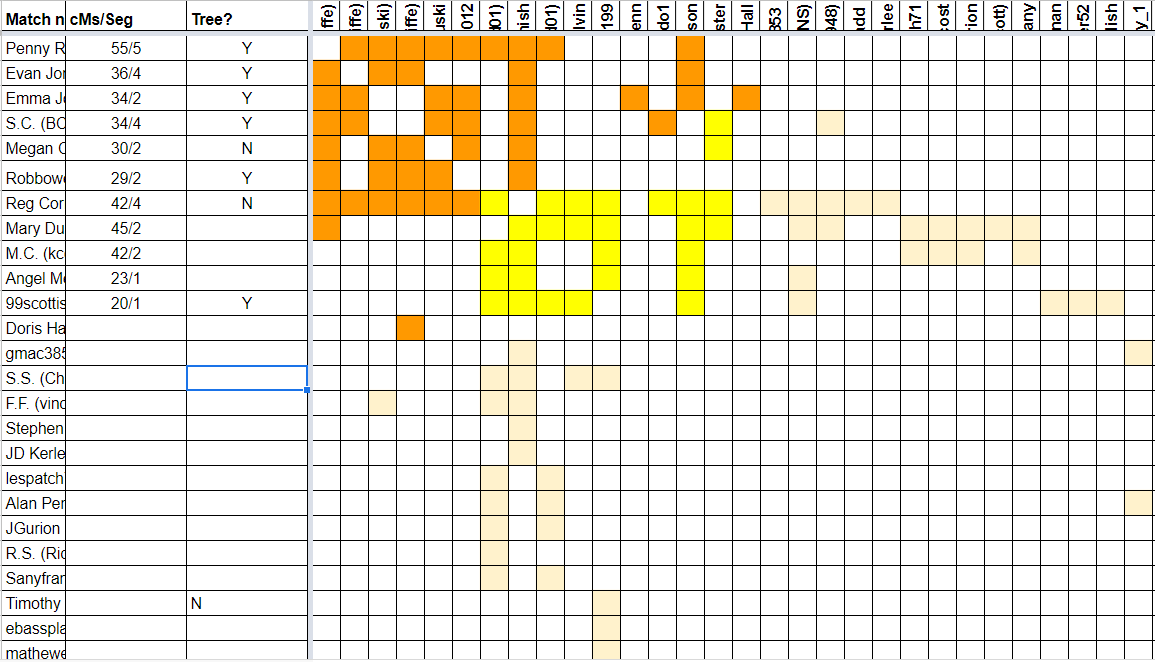
It’s an iterative process - comparing each of the matches with each other and doing this for each of the kits I had access to.
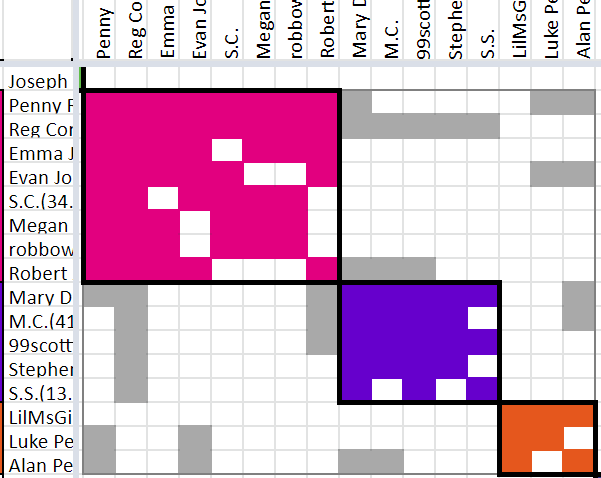
This resulted in not only the Stewart/McLellan cluster - but I have also identified another two sub clusters of shared matches within this group, which I’ve labelled the NZ and US clusters.

Many of those in the New Zealand cluster including Sue, did have trees and the patriarch in their tree is a James McLellan born c1816 who married Janet Morris in Barony, Glasgow in 1838. They immigrated to New Zealand in 1842 and had 9 children.
I have been able to identify nearly 40 of these shared matches as being descendants of James and Janet through 6 of their children. I’ve added this family as a floating branch in my tree and have also added a comment seeking contact with descendants of this couple. I have messaged all the matches but sadly response rates have been low.

However, two of those who have replied, Karen and Sandra, have also kindly shared their results with me and you can see their groupings here. Interestingly, neither appear to share any of the US Cluster matches, which is obviously another clue I need to explore further!

I'm pretty certain that James is the 7th child to James McLellan and Agnes Ross, but further research at the chromosome level is required to provide further evidence to support this theory.
The great majority of our shared matches have only tested at Ancestry and while I have encouraged others to upload to other sites with a chromosome browser, I only have segment data for a small number of matches, so identifying triangulated groups is an ongoing project.
I am hoping that some more of our NZ matches will read this blog and upload to some of the sites with a chromosome browser in the near future - so stay tuned for part 2!
Updated Family Tree
Below is an updated pedigree for mum, showing a further two generations on the McLellan line.

Note
Further reading
Scotland Starts Here - Castle of St. John Stranraer
National Library of Scotland - Map Images